The Nest
Stranger in a Strange LandThe Nest is the communal home built around Mike’s teachings, but it is more than a residence: its rooms, rituals, and shared resources make belonging a practiced relationship rather than a private claim. New members enter through graduated training and water-sharing; money is kept for common use; partners form within a wider family. When the Temple is destroyed, the Nest’s people escape and reorganize, showing that the community can survive the loss of its physical center.
Home and Shared Resources
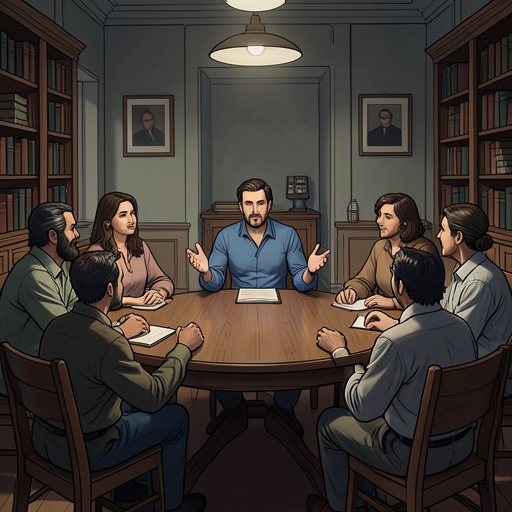
The Nest’s Innermost Temple is a large, circular room with a soft floor and a central pool. Patricia Paiwonski identifies it as the place where new brothers are received. Its use gives the home a ceremonial center: what might look like a private household space is also where the community marks a change in membership. When Patricia invites Ben Caxton to share water or swim, he declines; she accepts his hesitation with the community’s principle of waiting rather than treating refusal as a breach.
The Nest also gives members practical support through a shared-money arrangement. Cash is kept in bowls near the street door, where members can take what they need when leaving and return what remains if they remember. Patricia replenishes the supply from Mike when it runs low. Ben recognizes the bowls as a transition between the Martian custom of common resources and Earth’s money economy, sustained by Mike’s fortune. The arrangement does not abolish money: it makes access and replenishment communal within the Nest, rather than treating each person’s cash as strictly private property.
That practice connects to Mike’s own gradual understanding of money. He comes to see money not as the physical bills and coins but as an abstract system of symbols, a structure for balancing and connection. His gifts to friends likewise teach him what property means on Earth: an object can be passed to another person as a gift. The Nest therefore does not simply reproduce a moneyless Martian order; it creates a local way of sharing within Earth’s economy, while exposing how much social life depends on learned ideas of ownership.
Initiation and Belonging
Membership develops through circles of training rather than a single act of admission. Mike may offer water before a person reaches the Seventh Circle, as he did with Sam and Ruth when they had just entered the Third. Others may recognize someone for special training, but Mike is described as the one who can judge an early initiation with certainty. The later movement into the Eighth Circle leads toward broader sharing; entry into the Ninth Circle and the Nest is marked by a communal Sharing-Water service, usually welcoming a couple as lasting members.
Ruth recalls how that progression changed her own understanding. She and Sam learned the language and advanced through the circles; at the Third Circle, Mike and Jill offered them water. Ruth describes the experience as unsettling as well as transformative: she struggled with judgments about herself and her marriage, yet wanted to return to sharing water. The community then guided them through the inner circles at a pace meant to help them reach the Nest. Before the final ceremony, Ruth feared that she could not merge her life with the larger group and nearly asked Sam to turn back. In the Innermost Temple, the gathering called them to the pool; she entered and describes herself as having remained part of that belonging ever since.
The rite depends on consent and trust, not simply on the group’s decision to include someone. When Patricia is invited to share water with Mike and Jill, they explain that it signifies enduring partnership and mutual trust, and warn her not to accept if it conflicts with her faith or conscience. Patricia chooses to participate. Her decision extends kinship across religious difference: she can join the bond without first becoming a member of the same church. The rite is presented as serious and lasting, but the invitation leaves room to decline.
Jill’s initiation ceremony for new candidates makes the process visible to Ben. During the service, he sees Jill in the role of Mother Eve, and the candidates approach her in turn. Patricia leads Ben away before the ceremony is complete, so he does not witness the full sequence. The episode positions him at the threshold: close enough to feel the attraction of the gathering, but not yet ready to enter it. Later, members reassure him that he belongs and that the community will welcome him when he is ready.
Kinship and Partnership
The Nest’s kinship is both ritual and daily practice. A full Sharing-Water can make newcomers part of the whole community, while individual bonds continue to take different forms. Sam explains that members often become partners within the larger group, usually, but not necessarily, with their legal spouses. When a partnership shifts, he says, the change need not produce heartache or hostility; the relationship can remain warm and close. Partnership is not restricted to a man and a woman, and he points to Jill and Dawn as people who work together with unusual coordination.
This account complicates outside assumptions about who belongs to whom. Jubal Harshaw has thought of Jill and Dawn as Mike’s wives, but Sam explains that they are no more exclusively his than they are partners of the other members. Mike has been occupied with sharing himself across the group, while Patricia’s bond with him is described as especially spiritual. The Nest’s structure thus treats intimacy as something held within a community, rather than as a set of exclusive claims that define the whole household.
The ceremonies also give observers distinct positions. Ben, initially uneasy about the idea of taking on more sharing brothers, watches the household’s customs before he understands them. At the Innermost Temple he declines Patricia’s invitation; later he is told that he already belongs in an important sense, though the Nest has not yet held his formal welcome. Jubal, too, must come to understand that participation exceeds the simple exchange of water. The community’s process allows belonging to be gradual: training, observation, consent, and shared ceremony each contribute to a change in status.
A Community Under Pressure
The Nest’s organized life is vulnerable to the political and economic order around it. Sam argues that the community challenges established assumptions about property and marriage, not merely the behavior of a few individuals. If disciplined members can act without being stopped by bank vaults, or can understand markets better than those who trade in them, conventional institutions may be unsettled. Sam also cautions that Mike does not want members to exploit those abilities for large gains. In this account, the Nest’s shared discipline is both an alternative social practice and a source of friction with the wider world.
That conflict becomes immediate when the Temple is attacked. After arrests leave Mike in jail, the members gather in the Innermost Temple for a special Sharing-Water in his honor. The building is set on fire while they are inside, and the gathering is cut off; the community escapes to an emergency Nest. They lose the Temple and many belongings, although Mike has secured clothes and cash for them. The attack destroys a center of worship and communal life, but the members’ readiness to move together prevents the loss from dissolving the group.
The Nest’s method of survival is dispersal and renewal. Mike had already sent parents and children to other cities, with plans to establish temples there, leaving only about a dozen people to move at the time of the fire. In temporary quarters, Jubal notices that the ordinary distinctions of dress and undress have become less important to him as he settles into the close-family atmosphere. Ruth and Sam return from a distant assignment preparing a branch temple, and the reunion is treated as a family gathering. The Nest is therefore not confined to one building: its members can reassemble across locations and continue the work.
Continuity After the Temple
The congregation anticipates repeated closures and relocations. Sam describes a plan to reopen under different names and in different places when authorities force a group to close, building a disciplined core able to endure persecution and bring advanced pilgrims back into contact. He sees the destroyed Temple as a setback in appearance, not a final defeat. The Nest remains the durable social center beneath changing public institutions and addresses.
Its endurance is also expressed through ritual. When Mike awakens during a full Sharing-Water of the Nest, Jubal learns that the ceremony joins the whole community and that Mike’s participation helps hold them together. After Mike’s death, Jill urges Jubal to understand that he is not simply gone from those who have learned to share his life. The Nest’s members do not treat that conviction as a reason to stop acting: they speak of establishing additional homes when needed and continue planning new temples, including the resources and time required to support them.
The final image is of the community continuing its ordinary work. Over a modest meal, Sam and Saul discuss founding other temples and raising capital, including support for members who need to spend time on Mars. Jubal answers that money is no problem. The conversation brings the Nest’s defining tension back into view: it aims to live by sharing, but must still negotiate the institutions and material needs of Earth. Its continuity lies not in escaping those conditions altogether, but in carrying its practices of mutual aid, chosen kinship, and disciplined belonging into whatever home comes next.